


By: M A Dar
Jammu, May 26, 2025 – The High Court of Jammu & Kashmir and Ladakh has held that summons issued under the Prevention of Money Laundering Act, 2002 (PMLA), remain valid even if the person has been discharged in the predicate offence, reaffirming the independent character of money laundering investigations.
The judgment came in a plea wherein the petitioner sought quashing of the Enforcement Case Information Report (ECIR), the summons under Section 50 PMLA, and related actions, on the ground that he had already been discharged by the Special NDPS Court in December 2024.
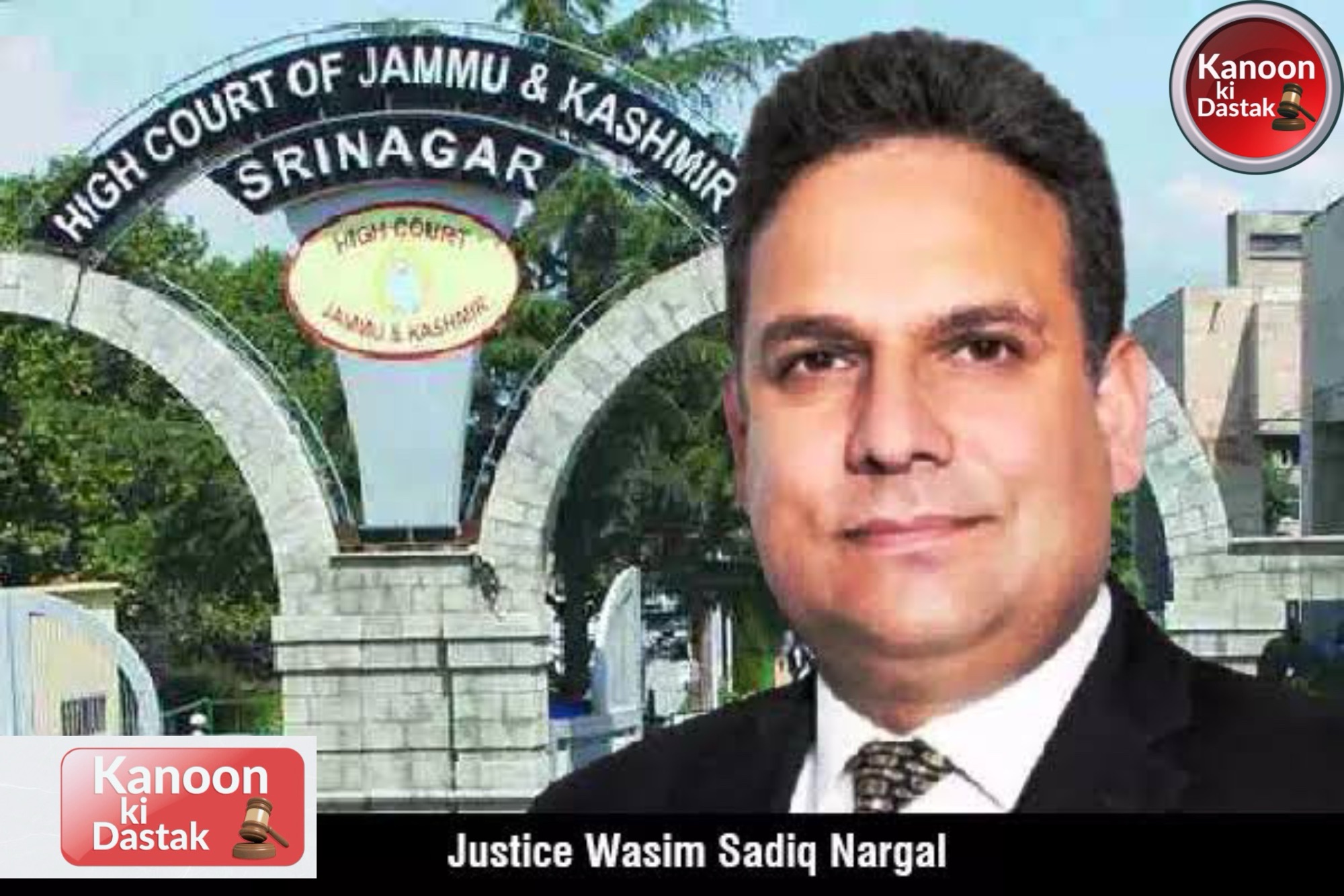
However, Justice Wasim Sadiq Nargal rejected the plea, emphasizing that discharge in the predicate offence under NDPS Act does not automatically render PMLA proceedings illegal.
Key Judicial Finding
“The summons issued to the petitioner constitutes a procedural measure within the legal framework, and its validity persists despite the petitioner’s discharge in the predicate offence.”
The Court made it clear that the offence of money laundering is a distinct and continuing offence, separate from the original (scheduled) offence such as those under the NDPS Act or IPC. The Enforcement Directorate (ED) can investigate and summon individuals if there is evidence indicating concealment, possession, or use of proceeds of crime, even if the predicate offence has resulted in discharge.
The High Court extensively relied on the Supreme Court’s decisions in Vijay Madanlal Choudhary v. Union of India and Directorate of Enforcement v. Vilelie Khamo, where it was held that PMLA investigations and summons do not automatically fall with the quashing or discharge of the scheduled offence.
“Simply because [a person] has been discharged in the predicate offence, a court cannot quash the summons,” the Supreme Court had earlier ruled in Vilelie Khamo (2024).
The petitioner argued that there were no “proceeds of crime” after being discharged, and thus, ED’s actions amounted to harassment. The Court rejected this, noting:
“The Enforcement Directorate’s authority to summon individuals under Section 50 is for collecting evidence… issuance of a summons does not automatically designate someone as an accused.”
It also pointed out that a criminal revision challenging the discharge order is pending, and hence, the matter cannot be considered closed.
Concluding the 34-page Judgment, the Court Observed:
“The ECIR is not merely an extension of the FIR; it is governed separately under the PMLA. Discharge in the predicate offence may influence but cannot conclusively annul PMLA proceedings.”
Accordingly, the petition was dismissed, affirming the ED’s powers to continue investigation and enforce summons under the PMLA.
Senior Advocate Sunil Sethi with M/s Nitin Parihar & Siddharth Jamwal, Advocates appeared for the petitioner.
Deputy Solicitor General of India, Vishal Sharma, appeared for the respondent.