

Kanoon Ki Dastak
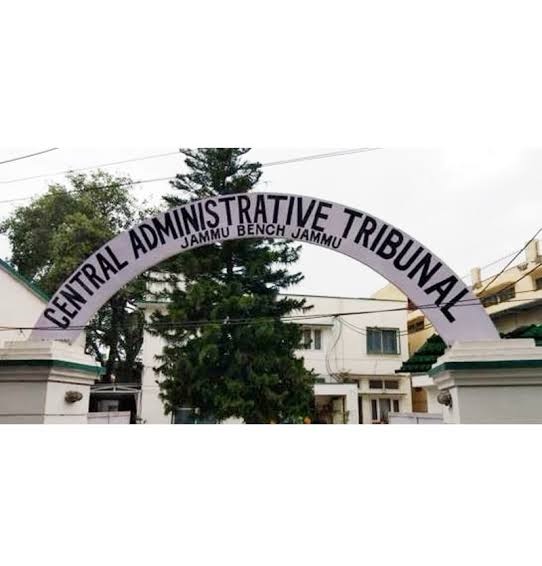
In a landmark judgment, the Central Administrative Tribunal (CAT), Jammu Bench, has quashed the 25-year-old discharge order of Jahangir Khan, a former Selection Grade Warden in the J&K Prisons Department, terming the action of the government as illegal, arbitrary, and in gross violation of constitutional safeguards and service rules.
The Tribunal further directed the State to pay 50% of back wages along with all pensionary and retiral benefits, to be disbursed within two months.
The judgment was delivered by a Division Bench comprising Sanjeev Gupta (Judicial Member) and Ms. Pragya Sahay Saksena (Administrative Member) in T.A, which was earlier filed as a writ petition before the J&K High Court and later transferred to the Tribunal following reorganization of service matters jurisdiction.
Jahangir Khan was appointed as Warden in the J&K Prisons Department on 28.08.1980 and promoted to Selection Grade in 1994. In 1999, while posted at District Jail, Kathua, a complaint was filed by his wife alleging that he had contracted multiple marriages without prior government sanction.
Without holding any formal inquiry or issuing a show cause notice in accordance with the J&K Civil Services (Classification, Control and Appeal) Rules, 1956 and the J&K Employees (Conduct) Rules, 1971, Khan was summarily discharged from service on 16.02.2000 by the Additional Director General of Prisons, J&K.
Khan challenged the discharge through a writ petition in the J&K High Court, which advised him to approach the Appellate Authority. Despite filing an appeal and several representations, no decision was taken, even after specific court directions in 2000 and again in 2011, compelling Khan to approach the courts multiple times, including through a contempt petition in 2012.
The Tribunal noted that although the respondents claimed the appeal was rejected in 2000, internal notings accessed through RTI by the applicant showed that:
The inquiry was re-initiated in 2004. A new inquiry officer was appointed. A show cause notice was served only in 2009. The applicant’s reply along with affidavits was submitted in December 2009. Yet, no decision was taken until vague communications were issued in 2012 and 2013, asserting that the review stood disposed of long back.
The Tribunal found the entire inquiry process non-existent in legal terms, observing that neither a regular charge sheet, nor opportunity to defend or cross-examine witnesses, was provided, thereby violating the principle of audi alteram partem.
The Tribunal held that:
The impugned discharge order dated 16.02.2000 was issued without following mandatory procedures under Article 311 of the Constitution of India, Section 126 of the erstwhile J&K Constitution, and *Rule 33 of the Civil Services Rules, 1956. The subsequent delay in deciding Khan’s appeal amounted to administrative apathy and lack of due process. Even assuming allegations of bigamy had some factual basis, the respondent authority could not bypass due process and impose a major penalty like discharge without formal inquiry.
It relied on the precedent Parveeza Akhter vs. State of J&K, where the J&K High Court had similarly quashed a termination for want of proper inquiry, reaffirming that constitutional protections cannot be diluted merely due to administrative convenience.
Though the applicant has reached the age of superannuation, the Tribunal held that he was entitled to pension and 50% back wages as compensation for the illegal deprivation of his service.
It rejected his prayer for full back wages, citing that no evidence was furnished to prove he was not gainfully employed during the intervening period. The Tribunal directed the authorities to complete the exercise of calculating and disbursing benefits within two months, failing which interest at 6% per annum would be applicable on the delayed amount.
Khan’s counsel, Mr. Aseem Sawhney, welcomed the verdict, stating that it restores the dignity of an officer who was hounded unfairly without proper investigation or lawful process.